How to divide household chores fairly.
Updated
Write down every task, including the invisible ones like planning meals, refilling supplies and booking appointments. Agree how often each one really needs doing. Then split by who minds a task least and who has the time that week, not by counting who did more.
Rotate the jobs nobody wants, and sit down once a month to adjust. Fair rarely means equal tasks. It means each person ends up with a similar load of work and a similar share of the jobs they dislike.
We Both lets you assign each chore to anyone in the house, repeat it on a schedule, and hand it off when plans change, with no points or scores to argue about.

 Or scan with your iPhone camera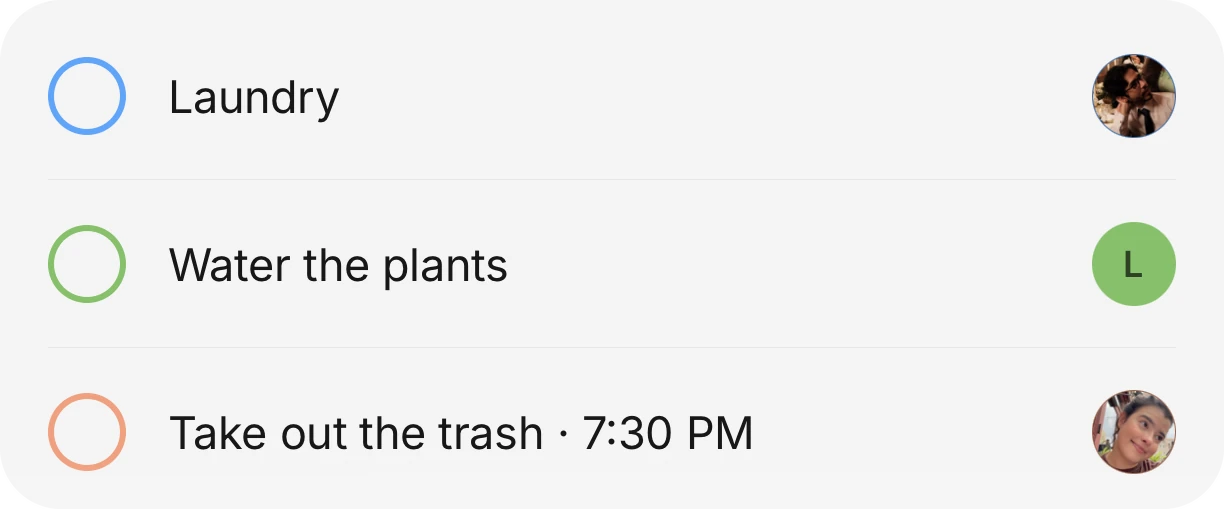
Step 1: list everything, including invisible work
Most arguments about chores start because two people are counting different lists. Sit down together and write out all of it, not just the visible tasks.
- The daily basics: dishes, trash, tidying, cooking, feeding pets.
- The weekly ones: laundry, bathrooms, vacuuming, groceries, changing the sheets.
- The rare ones: deep cleaning, filters, car upkeep, seasonal jobs.
- The invisible work: deciding what to eat, noticing the soap is low, remembering birthdays, scheduling the dentist, handling the paperwork.
Step 2: agree how often each one needs doing
A bathroom cleaned weekly by one person and “whenever it looks bad” by the other will never feel fair. Put a frequency next to every task: daily, weekly, every two weeks, monthly. Disagreements about standards come out here, which is better than finding them in week three.
Step 3: split by preference and time, not by tally
Keeping a tally of who did what turns the house into a scoreboard, and someone is always losing it. Start from preference instead: ask each person which tasks they mind least, give out those first, and share what is left. Then look at time. The person working long hours this month takes lighter chores, and that swaps back later.
| Method | How it works | Best when |
|---|---|---|
| Trade by preference | Each person picks the jobs they dislike least | Everyone has clear likes and dislikes |
| Rotate | Tasks move to the next person every week or month | Most jobs are equally disliked |
| Fixed owner | One person owns a task for good | One person is much better at it or cares more |
| By available time | Load follows whoever is home or free | Schedules are very different |
Step 4: rotate the ones nobody likes
Every home has two or three jobs that everyone hates. If one person always gets them, resentment follows. Put them on a rotation, even if you both feel the other is better at them, so the unpleasant part is shared by turns.
Step 5: revisit it every month
A split that was fair in January is not fair after a new job, a baby or a bad month. Put a recurring ten-minute check-in on the calendar. Ask what felt heavy, what got skipped, and what to trade. Adjust it without blame.
How We Both handles it
Every chore in We Both can be assigned to anyone in the house and repeated daily, weekly on chosen days, every two weeks, monthly or on a pattern like the first Saturday. Chores with no date, the “whenever” kind like cleaning the oven, sit on a list and never turn overdue. You can plan one onto a day when you have time.
If plans change, hand a chore to someone else, skip it once or move it once. There are no points, streaks or leaderboards, on purpose. The goal is a house where the work gets done, not a ranking of who did more.
Chore apps for roommates →Questions people ask
Should chores be split 50/50?
Equal time is a good starting point, but fair depends on circumstances. If one person works far more paid hours, a fair split usually shifts toward the person with more time at home.
What if one person does not do their share?
Skip the scorecard and talk about the specific task. Ask what is in the way, whether the frequency or the owner needs to change, and agree on one small fix to try for a month.
Does We Both keep score of who does more chores?
No. We Both has no points, streaks or leaderboards. It shows what is assigned to whom and what is due, and leaves the conversation about fairness to the people in the house.
How do you handle chores nobody wants to do?
Rotate them on a fixed schedule, or pair them: whoever cooks does not do the dishes. If a job is truly awful, consider paying a cleaner for it and sharing the cost.
Get the whole house on it.
Download it free, then invite everyone you live with. They see the same list, the same calendar and the same money.
Or scan with your iPhone camera